McKinsey Three Horizons Framework (H1, H2, H3): Definition, Examples & How to Apply It

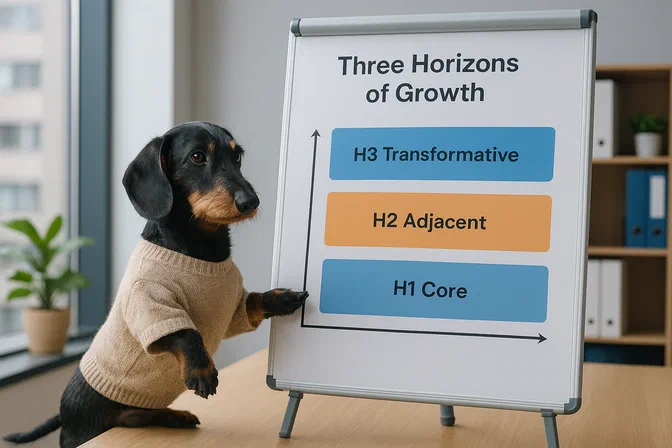
This is one of RoadmapOne ’s articles on Objective Tagging methodologies .
The McKinsey Three Horizons model is a portfolio framework that sorts growth initiatives into three time-based horizons: Horizon 1 (H1) defends and extends today’s core business, Horizon 2 (H2) builds emerging businesses expected to scale in two to three years, and Horizon 3 (H3) seeds transformational bets that might redefine the company in five to ten years. The discipline is investing across all three at once, not sequentially.
Every product leader has faced the dreaded question: “Why are we investing in something that won’t pay off for five years when this quarter’s churn is spiking?” McKinsey’s Three Horizons framework turns that defensive moment into a strategic dialogue. By plotting initiatives across three time-bound horizons, teams defend core revenue while planting seeds for outsized future growth. It is one of the eight strategy frameworks for product leaders I keep in the kit bag — a portfolio-timing lens rather than a competitive-positioning one, which matters when you pick which framework to reach for.
1. Origin Story: From Oil Fields to SaaS Sprints
The framework emerged from McKinsey’s late-1990s work with energy giants grappling with near-term production declines and multi-decade exploration projects. Consultants borrowed portfolio theory from finance, married it with the technology adoption lifecycle , and the Three Horizons model was born:
- Horizon 1 (H1): Protect and extend the core business.
- Horizon 2 (H2): Build emerging businesses that could scale in 2–3 years.
- Horizon 3 (H3): Create optionality for wholly new lines that might redefine the company in 5–10 years.
The idea soon leapt to software as companies like Google and Amazon tackled similar time-scale conflicts.
2. Dissecting the Horizons in a SaaS Context
Horizon 1: Defend the Castle
In SaaS, H1 means shaving churn, upselling existing customers, and keeping NPS high. Typical H1 moves:
- Enhance core workflows users already pay for.
- Improve performance and reliability to sustain SLA commitments.
- Adjust pricing and packaging to capture incremental value.
Metrics are well known—ARR growth, gross churn, support ticket MTT R.
Horizon 2: Build the Bridge
H2 feels like a scale-up inside the scale-up. You have early proof, maybe a standalone P&L, but the playbook still evolves. Examples:
- Launching a vertical-specific edition based on existing platform primitives.
- Expanding to a new geography with local compliance features.
- Monetising ecosystem integration via marketplace fees.
Key ratios include CAC payback and attach rate. Teams often spin up a semi-autonomous squad with its own backlog, marketing funnel, and performance dashboards.
Horizon 3: Scout the Frontier
H3 bets are pure exploration—an AI-driven predictive module when you currently sell workflow automation, or a platform leap from SaaS to PaaS. Funding is milestone-based; success criteria are learning velocity rather than revenue. Artifacts include discovery prototypes, design-partner agreements, and patent filings.
3. Why One Horizon Often Devours the Others
Without intentional governance, H1 firefighting steals engineers from H3, while H2 ambitions die in annual planning because finance struggles to model mid-term upside. The horizons only hold if there is a real strategy underneath them — a diagnosis, a guiding policy and coherent action , not a list of growth goals dressed up as one. The result is a lopsided portfolio that maximises short-term EBITDA but underinvests in future relevance—a slow-motion Kodak moment.
4. Implementing the Model Inside a Quarterly Cadence
- Tag every initiative with H1, H2, or H3. RoadmapOne enforces that objectives be correctly tagged
- Set investment targets—e.g. 60 % H1, 25 % H2, 15 % H3. Targets shift as the company matures. (For a similar allocation approach, see Run-Grow-Transform and the Innovation Ambition Matrix .)
- Review drift monthly. If H1 creeps past 70 % for two quarters, throttle Run projects or earmark incremental budget for H3 discovery.
- Publish a public roadmap slice showing only Horizon tags and high-level outcomes. Investors appreciate transparently balanced ambition.
5. Case Example: Fintech Scale-Up AlphaPay
In 2022 AlphaPay’s entire backlog was eating support debt. NPS nose-dived. The CPO introduced Three Horizons tagging:
- H1 (Run): Payment-gateway resilience improvements.
- H2 (Grow): BNPL white-label product for merchants.
- H3 (Transform): Crypto settlement research.
Within six months, engineers rotated through horizons, burnout fell, and investors applauded the 20 % of spend earmarked for an H3 “call option” in decentralised finance—catnip for the Series D round.
6. How RoadmapOne Makes Horizon Tagging Frictionless
- Custom Tag Sets: RoadmapOne ships with an template tag group named “Horizon.”
- Portfolio Slice: The visual prioritisation board lets execs drag initiatives between horizons, watching allocation charts update live.
- Scenario Modelling: Duplicate a roadmap, tweak the horizon mix, and instantly compare projected ARR curves. (See our guide on master vs scenario roadmaps .)
7. Practical Tips
- Use RoadmapOne to Link Horizon tags to OKRs —so H2 objectives aren’t judged by H1 metrics.
- Rotate staff intentionally to avoid siloed mindsets.
- Hold a quarterly “H3 Demo Day.” Even if prototypes fail, they teach.
Frequently Asked Questions
What is McKinsey’s Three Horizons model?
McKinsey’s Three Horizons model is a portfolio framework for balancing short-, medium- and long-term growth. Horizon 1 protects and extends the profitable core, Horizon 2 builds emerging businesses expected to scale within two to three years, and Horizon 3 funds exploratory bets that might redefine the company in five to ten years. The point is to invest across all three simultaneously, not one after the other.
What is the difference between Horizon 1, Horizon 2 and Horizon 3?
Horizon 1 is your core—the products generating revenue today, where you defend margin and shave churn. Horizon 2 is the bridge—emerging propositions with early proof and often their own P&L, on a two-to-three-year path to scale. Horizon 3 is the frontier—research-stage options judged on learning velocity rather than revenue, with a five-to-ten-year payoff and a high chance of failure.
What percentage should be allocated to each horizon?
There’s no universal split, but a common starting point is roughly 60–70% Horizon 1, 20–25% Horizon 2 and 10–15% Horizon 3, shifting as the company matures. A cash-strapped scale-up leans harder on H1; a mature incumbent facing disruption needs more in H3. What matters is that the allocation is deliberate and visible in your capacity plan , not an accident of whoever shouted loudest in planning.
What is a Three Horizons roadmap?
A Three Horizons roadmap tags every initiative by horizon so leadership can see, at a glance, how investment is spread across defend, build and explore. Rather than a feature timeline, it’s an allocation view: how much engineering capacity is protecting today’s revenue versus seeding tomorrow’s. Tools like RoadmapOne make the tagging and the live allocation chart frictionless, so the balance is a conscious decision rather than a surprise.
What are examples of Horizon 3 technologies?
Horizon 3 covers bets that don’t yet have a proven market: an AI-driven predictive module for a company that currently sells workflow automation, a leap from SaaS to a platform play, or crypto settlement research inside a payments business. They start as discovery prototypes and design-partner agreements, funded milestone by milestone and measured on what you learn, not what you earn.
Is the Three Horizons model still relevant in the AI era?
It’s still a useful lens, but the timescales have compressed. When build cost was high, an H3 bet genuinely took five to ten years to mature. Now that AI has collapsed the cost of building, the hard part of most H3 ideas isn’t the technology—it’s distribution and convincing a customer to buy. Treat the horizons as a way to keep the portfolio balanced, not as fixed calendars.
8. Bottom Line
Balancing the three time-frames means saying “no”—or at least “not yet”—to pet projects that fall outside their horizon’s mandate. Tagging enforces that discipline, and RoadmapOne removes the mechanical pain so leaders can focus on the strategic tension that really matters: betting yesterday’s cash on tomorrow’s relevance.
Approx. 1,900 words
For more on Objective Tagging methodologies, see our comprehensive guide .
