OKRs for Product Managers & Product Teams: Why Most Fail (How to Fix)
What private equity sees when you tell them you use OKRs — and the CPO playbook to fix it before the value creation plan does it for you


In dozens of due diligence engagements I’ve run for private equity firms, I can count the companies actually doing OKRs on the fingers of one hand. If you’re a CPO and your OKRs are really a feature list, this article is for you.
OKRs (Objectives and Key Results) for product teams pair a qualitative Objective — a customer or business problem worth solving — with 3–5 measurable Key Results that prove the problem is being solved. Leadership sets the Objective; the empowered product team defines the Key Results and finds the solution. Done properly, OKRs are the artefact that connects engineering spend to business outcomes.
About 75% of the product and engineering teams I assess in PE due diligence claim to use OKRs. In almost every case, what they actually have is a wishlist of features that came out of an ExCo meeting at the start of the year or — slightly less bad — at the start of the quarter. “Build the integration with Salesforce.” “Add a new reporting view.” “Ship the mobile redesign.” None of these are objectives. None of them are problems to solve. They’re features dressed up in OKR language.
That difference matters more than most CPOs realise. It’s the difference between a RoadmapOne -style empowered product team that the board sees as the engine of the business, and a feature factory that ends up as the first line item the value creation plan goes after. The modern feature factory has learned to speak fluent OKR — it just never actually delivers the outcomes, and when engineering capacity is summed against the board’s growth plan the fiction becomes visible.
TL;DR: Most “OKRs” I see in PE due diligence are feature wishlists with the word “objective” written above them. The root cause is never the framework — it’s a CEO and ExCo who can’t bring themselves to set problems and let empowered teams find the solutions. The cost is brutal: P&E gets reframed as a cost line rather than a value driver, and a 20% headcount reduction lands in the first six months of the value creation plan.
The fix is not a transformation programme. It’s a quarter-on-quarter rebuild of credibility, starting with the simplest move imaginable: instead of “we need to build X”, write “we need to deliver business outcome B by delivering feature X.” That’s an Objective and a Key Result. You haven’t taken anything away from the ExCo — you’ve added the thing that lets you eventually wean them off the spec.
The 75% Problem: What Private Equity Sees in Your OKRs
When I’m doing due diligence on behalf of a PE firm, the OKR slide is one of the first things I want to look at. Not because the framework matters — most deals don’t hinge on which goal-setting methodology the target uses — but because the OKR slide tells me how product is actually run.
Most of what I see is the same pattern repeated:
- A long list (10, 15, sometimes 30 line items) of work the company plans to do this quarter or year.
- Items framed as deliverables: “Build X”, “Launch Y”, “Migrate Z”.
- No connection to a customer problem or a business outcome.
- No baseline metric, no target metric, no measurement plan.
- An ExCo signature at the bottom that means everyone in the room nodded along.
That’s not OKRs. That’s a feature backlog with executive sponsorship. And here’s the thing: the people who put it together genuinely believe they’re doing OKRs. They’ve read Doerr. They’ve been to the workshops. They’re using the right vocabulary. They’ve just systematically stripped out the empowerment that makes the framework work, and replaced it with the thing that makes ExCo members feel safe — a list of features they recognise.
The rare companies that are actually doing OKRs look completely different. The list is shorter (2–3 objectives per team). Each one is framed as a customer or business problem. Each has measurable key results that someone outside P&E (usually finance) can audit. And the CEO can’t tell you exactly which features will be built — because that’s not their decision to make.
Why This Happens: The Empowerment Failure
The framework isn’t broken. The companies are.
The single most common root cause I see is a lack of empowerment of the product teams. The CEO has decided they want to operate at the feature level — “build the integration with X” — and the rest of the organisation falls in line. ExCo people are usually type-A leaders. They’ve spent a career being the smartest person in the room, and that doesn’t switch off when the conversation turns to product. They forget how to be humble. They forget that the team living and breathing the customer problem all day is uniquely positioned to find the right solution. So instead of setting problems and reducing roadblocks, they specify features.
The worst version of this I’ve seen was a CEO who’d been pushing a “feature X this month, feature Y next month, feature Z the month after” pattern for at least five years. No connection to outcomes. No coherent strategy. Just a constant stream of executive opinions about what should be built. The company survived only because the core proposition was strong enough to weather the buffeting — there’s a separate article on why constant priority changes destroy product teams , and this is exactly the failure mode it describes.
It gets worse when other ExCo members join in. Marketing has its own pet feature (“we just need K so I can run the campaign”). Sales wants a contract feature for a deal they’re chasing. Customer Success wants a self-service module. Each function arrives with a feature request and the assumption that P&E exists to deliver it. The product team becomes a project office. Cross-functional teams are part of the answer here — when the people from Marketing, Sales, CS and Engineering are all sitting in the same squad working on the same outcome, the “just build K” requests get debated against the actual problem the team is solving, not just nodded through. This is also where genuine product discovery starts to replace specification — the team validates what would actually move the outcome before committing capacity to it.
The other reason this persists is inertia. Most executives have never seen a truly empowered product team in action — the kind described in Marty Cagan’s product operating model . They don’t know what they’re missing, so they default to what they know — specification and oversight. You can’t teleport an organisation to empowerment. You have to build the credibility for it, quarter by quarter, by demonstrating that empowered teams ship outcomes more reliably than directed teams ship features. That credibility-building runway is the bridge between output-based and outcome-based roadmaps .
The Cost: When P&E Stops Looking Like a Value Driver
Here’s where this hurts. When OKRs are really a feature list, P&E stops being something the board can connect to business outcomes. Instead, it becomes a cost line.
I once got brought in by the board of a company to help them understand why they were spending so much on their P&E team but seeing no clear outcomes. The team was busy. They were shipping. The roadmap was full. But nobody could draw a clean line from “we spent £X on engineering” to “the business is £Y better off.” So the question, quite reasonably, became “how much P&E headcount can we remove?”
When PE walks into a deal, the default move on the deal team is to look for cost opportunities. P&E is usually a significant proportion of the cost base. If the target can’t point to what the P&E team has actually delivered in business outcomes, a 20% headcount reduction goes straight into the first six months of the value creation plan.
This isn’t theoretical. It’s the most common P&E intervention in mid-market PE deals. And it’s almost always avoidable — the team would have been protected if leadership had been able to articulate what the function delivered to the business.
This is the financial cost of feature-factory OKRs that nobody talks about. It’s not just morale, or culture, or “PMs feel disempowered” (though all of those are real). It’s that when a buyer or board can’t tie engineering spend to outcomes, the spend looks like waste. Real OKRs are the artefact that prevents that.
What Real OKRs Actually Look Like
Before getting to the playbook, let’s be clear what we’re aiming at.
OKRs are not one thing. They’re two:
Objectives
Objectives are concise, qualitative statements that describe a problem worth solving or a direction worth heading in. “Make checkout friction-free for first-time buyers.” “Win back the customers who churned in Q3.” They should be inspirational, memorable, and free of metrics — they pull the team toward a clear purpose without dictating the solution.
Key Results
Key Results are the specific, time-bound, measurable evidence that the objective is being achieved. “Reduce average checkout time from 90 seconds to 45 seconds.” “Reactivate 40% of Q3 churners by end of Q1.” Each Key Result is a milestone that proves whether ambition is becoming reality, and lets you course-correct early when the numbers drift. A quick note on that “average” — in many cases a distribution-aware KR (“p95 checkout time < 2 seconds”) is a sharper measure than a mean, because users do not experience averages : every user experiences one specific checkout time, and the tail is where churn happens.
I love the SVPG approach where Objectives are framed as “Problems to be Solved”: what is the specific problem you need solved, who specifically you need that problem solved for, and how you will measure success. If you can’t answer those three questions, you don’t have an Objective — you have a wish.
The pattern that turns this from a framework into a feature list is when the “Key Result” is actually a deliverable in disguise. “Launch the new checkout flow” is not a Key Result. “Reduce checkout abandonment by 25%” is. The first is something you ship; the second is something you achieve. If a Key Result can be “completed” rather than “achieved to a degree”, it’s an output masquerading as an outcome.
When drafting an OKR, force yourself to write it in this form: “We will [Objective] as measured by [Key Result(s)].” If the sentence reads naturally, you have an OKR. If it doesn’t — if you can’t articulate what success looks like in measurable terms — you have a feature spec, not an Objective.
For a deeper dive into how to categorise and tag your KRs, see our guide to Key Result Tagging . For how to frame Objectives strategically, see Objective Tagging methodologies . And for fully worked examples across acquisition, retention, monetisation and platform teams, see OKR examples .
The CPO Playbook: Five Moves to Fix Feature-Factory OKRs
You’re a Chief Product Officer. You’ve read this far because you recognised your company in it. Here’s what you actually do on Monday morning.
Move 1: Have the conversation with your CEO
The conversation goes like this: “We’re going to keep delivering the features you and ExCo care about. But for each one, I want to track the business outcome it’s supposed to deliver, so we can prove to the board what P&E is contributing.”
A good CEO should love this conversation. You’re not taking anything away from them — you’re adding the measurement layer that lets them defend P&E investment to the board, to investors, and to a future buyer. If you frame it well, you should walk out with their backing.
If your CEO doesn’t love this conversation, that’s a diagnostic moment. Either you’re in a feature factory and need to accept that, or it’s time to find a different job. There’s no third option where you implement real OKRs while the CEO is actively undermining the principle.
Move 2: Test your own product and engineering leadership
Same conversation, your direction. Sit down with your Head of Product and Head of Engineering and lay out what you’re going to do. The best ones should be jumping. They want to be measured on business outcomes. They want their teams to be commercial leaders, not feature shippers.
If they push back, if they prefer the comfort of a clear feature spec, if they can’t articulate the business problem behind a piece of work — you have a leadership problem before you have an OKR problem. Reassess their suitability for the role. You can’t run empowered teams with leaders who don’t believe in empowerment.
Move 3: Make the CFO your scorekeeper
This is the single highest-leverage move in the playbook, and it’s the one that gets skipped most often. Bring the CFO in. Make finance the official scorekeeper for OKR delivery.
One of the best things we did at Trainline was make the finance team the scorekeeper for every business outcome that mattered. Then there’s no way to cheat the numbers. The KR delivered or it didn’t. The conversion rate moved or it didn’t. There’s no PM who can quietly redefine success at end-of-quarter to make their team look good.
A good CFO loves this. They get a clear line of sight from engineering investment to business impact — exactly what they need for board reporting, and exactly what they’re usually missing. Get the CFO bought in and you’re most of the way there.
Move 4: Reorder the feature into outcome plus feature
This is the practical move that lets you start running OKRs immediately, even inside an organisation that still wants features specified.
Take the existing instruction. “We need to build the Salesforce integration.” Reorder it: “We need to deliver business outcome B by delivering the Salesforce integration.” Now you have an Objective (B) and a Key Result set (the integration is in production AND it’s delivered the outcome).
Concretely: if the existing instruction is “build Salesforce integration”, the empowered version becomes:
- Objective: Reduce sales cycle length for enterprise prospects who use Salesforce as their CRM
- Key Results:
- Cut average enterprise sales cycle from 84 days to 60 days
- Achieve 80% of qualifying enterprise demos using the integrated workflow within one quarter of launch
- Hit a CSAT of 8/10 from sales team users of the integration
You haven’t refused the executive ask. You’ve added the thing that lets you measure whether the executive ask was actually right. If you ship the integration and the sales cycle doesn’t move, you’ve learned something important. If it does move, you’ve earned credibility. Either way, you’ve started measuring outcomes.
Move 5: Wait for empowerment to arrive quietly
The thing nobody tells you about earning empowerment is that there’s no moment when you escalate to it. There’s no quarterly review where you announce “great, now I want to write the Key Results without the spec attached.” It just starts happening.
You’ll notice the change first in conversations that aren’t in the ExCo room. The CMO and your PM start discussing next quarter’s outcomes before the formal planning session. The COO stops bringing feature specs to the meeting and starts bringing problems. The CEO mentions an outcome rather than a deliverable. The cross-functional teams start framing their own work in customer terms without being asked to.
That’s empowerment arriving. It doesn’t come from a transformation programme. It comes from quarter after quarter of “we said we’d deliver this outcome and we did.” Credibility compounds, and at some point the organisation stops needing to specify the solution because they trust the team to find it.
It is, by the way, always a negotiation. Empowerment is not a destination. Everybody in the business has an opinion about the product, and that’s healthy — you want it. The job is to make sure those opinions are channelled through the right conversations between the right people, with the cross-functional team owning the call. The marker of a working system is the CMO arriving at the meeting already aligned with the PM on the roadmap for the next quarter, not arguing for their pet feature in front of the CEO.
Connecting OKRs to Roadmap Capacity
OKRs that aren’t connected to capacity are wishes. This is where most OKR implementations quietly fail in the second half of the quarter — the team committed to three objectives but had capacity for one and a half, and nobody noticed until the numbers came in flat.
RoadmapOne was built around this problem. Every objective is allocated to a specific squad for a specific number of sprints. The capacity is visible. The trade-offs are explicit. And the moment you allocate a fourth objective into a team that has capacity for two, it shows up as a red number rather than as a quiet over-commitment.
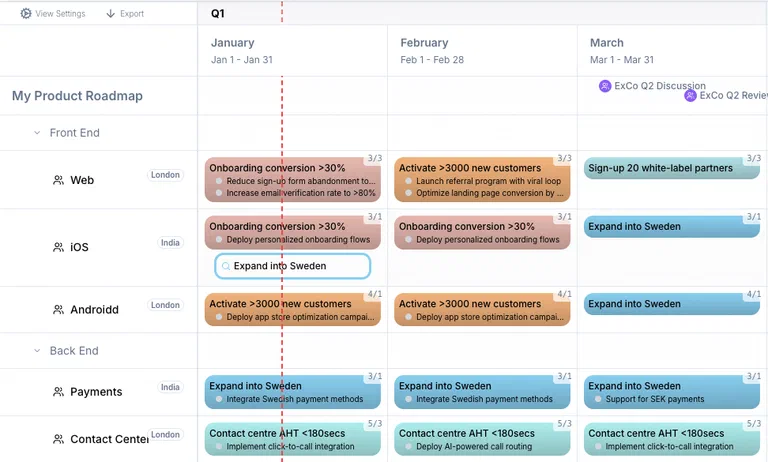
In the roadmap above, you can see the Web team focused on an Onboarding Conversion Objective during January, with two Key Results: reducing sign-up form abandonment, and increasing email verification rate. The capacity is visible. The objective is concrete. The KRs are measurable. That’s what the CFO can audit.
For a step-by-step approach to building this kind of roadmap, see our guide on how to build a product roadmap , and the deeper dive on capacity-based planning .
Common Pitfalls and How to Avoid Them
Even with the playbook in hand, there are predictable failure modes. These are the ones I see most often.
Pitfall 1: Output-Based Key Results
The most common failure. “Build the redesigned profile editor” is not a Key Result. “Increase profile completeness from 45% to 80%” is. If the KR can be “completed” rather than “achieved to a degree”, it’s an output in disguise. Always ask: what will change for the customer or business if we deliver this?
Pitfall 2: Too Many OKRs
Teams default to comprehensive coverage — eight or ten objectives per quarter — and dilute focus into nothing. Cap at 2–3 objectives per team per quarter, each with 3–5 key results. OKRs are meant to highlight your priorities, not document all your work. Use the 70/20/10 rule: 70% of capacity to primary OKRs, 20% to secondary priorities, 10% to exploration. See limiting work in progress for the structural side of this.
Pitfall 3: OKRs as Performance Reviews
The moment OKRs are tied to compensation or performance evaluation, teams set safe targets. Stretch ambition dies. Keep OKRs as a learning and alignment tool, not a judgement mechanism. Celebrate learning from missed targets as much as hitting them.
Pitfall 4: No Tracking Cadence
Setting OKRs once and revisiting them at end-of-quarter guarantees they fall out of focus. Build OKR review into existing rituals — sprint reviews, weekly product meetings, mid-quarter deep dives. The simple discipline that separates working OKRs from forgotten ones is referencing them in every sprint review. If it’s not a regular conversation, it’s not an OKR — it’s a forgotten document. This connects directly to quarterly planning rhythm .
Pitfall 5: Lack of Cross-Functional Alignment
Product OKRs created in isolation from engineering, marketing, sales and CS produce competing priorities. The cross-functional team is the unit of OKR ownership, not the product team alone.
Pitfall 6: Insufficient Metrics Infrastructure
Setting OKRs around metrics you can’t reliably measure leads to ambiguity at the end of the quarter. But don’t let this become an excuse to delay.
I see so many teams burning days or weeks building beautiful metrics infrastructure before they get started on the thing the customer cares about.
If you’re trying to improve conversion, you could go and tag the life out of everything in your funnel. Or — log an event at the top of the funnel, log another event at the bottom, and calculate the answer manually. Yes it’s clunky. But you’re weeks ahead in value delivery, and you can build the proper instrumentation later if the early signal is positive.
OKRs for Different Product Team Structures
The implementation should be adapted to your team structure. Different organisational models require different OKR approaches.
Component-Aligned Teams
If your organisation follows Conway’s Law and structures teams around technology components:
- Connect team OKRs directly to user or business outcomes, not just component improvements
- Create shared Objectives that span multiple teams
- Include integration-focused key results that measure how well components work together
- Pull from the front. The front-end teams set the tempo other teams dance to. From a Lean perspective, there’s nothing worse than a back-end team building a capability that the front-end can’t integrate for three months.
- Establish regular cross-team OKR reviews
Example: Authentication Team OKR
Objective: Make authentication frictionless while maintaining industry-leading security
- Increase first-attempt login success rate from 82% to 95%
- Reduce authentication-related support tickets by 40%
- Maintain 99.99% successful blocking of unauthorised access attempts
Cross-Functional Product Teams
If your teams are organised around customer journeys or product areas:
- Create OKRs that span the entire customer experience within the team’s domain
- Include metrics that measure handoffs between your area and adjacent ones
- Allow teams significant autonomy in defining OKRs while staying aligned with company objectives
- Share OKRs across teams to identify overlaps and dependencies
Example: Onboarding Team OKR
Objective: Create the smoothest onboarding experience in our industry
- Increase onboarding completion rate from 68% to 85%
- Reduce time to first value from 24 hours to 15 minutes
- Improve new user NPS from +12 to +40
- Increase 30-day retention of new users from 65% to 80%
Platform or Enabling Teams
If your team provides platforms or services to other product teams (sometimes called SAFe Enablers ):
- Focus OKRs on platform adoption, efficiency, and developer experience
- Include key results based on internal customer satisfaction
- Measure the impact of platform improvements on consuming teams’ velocity
- Co-create OKRs with the teams that consume your services
Example: API Platform Team OKR
Objective: Make our API platform the preferred integration method for partners and customers
- Increase API consumption from 15M to 50M calls per month
- Reduce API integration time for partners from 2 weeks to 3 days
- Achieve 90% satisfaction score from internal and external developers
- Maintain 99.99% API availability
Product Leadership Teams
If you’re part of a product leadership team responsible for the overall portfolio:
- Focus OKRs on portfolio-level outcomes that individual teams contribute to
- Include key results related to cross-product integration and consistent experience
- Measure how well the product portfolio addresses overall customer needs
Example: Product Leadership OKR
Objective: Become the comprehensive solution for mid-market financial operations
- Increase product adoption breadth from 2.1 to 3.5 modules per customer
- Reduce customer time spent switching between products by 40%
- Achieve 85% feature parity with best-of-breed point solutions
- Increase cross-product upsell conversion from 12% to 25%
Internal vs Customer-Facing OKRs: Tag the Split
One structural idea almost no OKR guide mentions: not every legitimate objective touches the customer. “Deployment frequency > 2/week” and “Change failure rate < 3%” are real, valuable objectives — but they’re internal effectiveness plays, and they should be visibly tagged as such.
Why does the tag matter? Because the board question is never “are these good OKRs?” — it’s “how much of our engineering capacity is improving the business versus improving ourselves?” A portfolio that’s 60% internal objectives is a warning sign, however beautifully each one is written. In RoadmapOne , internal objectives are explicitly tagged, so the internal/external split shows up in the same analytics view as your Run/Grow/Transform balance . That’s a thirty-second answer to a question that otherwise derails a board meeting.
Example of a well-formed internal OKR:
Objective: Make our release process boring — deploys should be a non-event
- Increase deployment frequency from fortnightly to 2+ per week
- Reduce change failure rate from 12% to under 3%
- Cut mean time to recovery from 4 hours to 30 minutes
Same discipline as a customer-facing OKR — baseline, target, auditable by someone outside the team — just honestly labelled as internal.
Connecting OKRs to the Customer Funnel (AARRR)
A useful structuring move is to align product OKRs with the Pirate Metrics (AARRR) framework . It ensures your objectives cover the full customer lifecycle and surfaces gaps in portfolio investment.
| Funnel Stage | Example Objective | Example Key Results |
|---|---|---|
| Acquisition | Become the top-of-mind solution for SMB finance teams | Increase organic signups by 40%; Reduce CAC from £200 to £120 |
| Activation | Make first-time users successful within minutes | Reduce time-to-first-value from 24 hours to 15 minutes; Increase activation rate from 45% to 70% |
| Retention | Build a product users can’t imagine leaving | Reduce monthly churn from 5% to 2%; Increase DAU/MAU ratio from 25% to 40% |
| Referral | Turn happy customers into advocates | Increase referral-driven signups from 10% to 30%; Achieve NPS of 60+ |
| Revenue | Maximise customer lifetime value | Increase LTV/CAC ratio from 2.5:1 to 4:1; Grow expansion MRR by 25% |
When you tag OKRs by funnel stage in RoadmapOne, you can immediately see whether you’re over-investing in acquisition while under-investing in retention — the leaky-bucket pattern that quietly destroys SaaS economics.
Frequently Asked Questions
What are OKRs in product management?
OKRs (Objectives and Key Results) are a goal-setting framework where a product team commits to a qualitative Objective — a customer or business problem worth solving — and 3–5 quantitative Key Results that measure whether it’s being solved. In the product operating model, leadership sets the Objective and the empowered team defines the Key Results and the solution. Their real function is connecting engineering investment to auditable business outcomes.
What are the 5 elements of OKR?
John Doerr’s five OKR “superpowers” are: Focus (2–3 objectives, not thirty), Alignment (team OKRs connect to company strategy without rigid cascading), Commitment (the team and leadership agree the objective matters), Tracking (progress reviewed in every sprint, not just quarter-end), and Stretch (targets ambitious enough that 70% achievement is success). Miss any one and the framework degrades into a feature wishlist with better vocabulary.
How do you write effective OKRs?
Use the template: “We will [Objective] as measured by [Key Results].” The Objective states a problem to solve — who it’s for and why it matters — without dictating the solution. Each Key Result needs a baseline, a target, and a measurement plan someone outside the team (ideally finance) can audit. If a Key Result can be “completed” rather than “achieved to a degree”, it’s a feature spec in disguise.
How many OKRs should a product team have per quarter?
2–3 Objectives per quarter, each with 3–5 Key Results. More dilutes focus and makes tracking overwhelming. OKRs highlight priorities, not all work. Use the 70/20/10 rule: 70% of capacity to primary OKRs, 20% to secondary priorities, 10% to exploration.
What’s the difference between OKRs and KPIs?
KPIs are continuous health metrics — uptime, NPS, revenue. OKRs are time-bound improvement goals that move specific KPIs. KPIs are the dashboard you always watch; OKRs are the specific improvements you’re driving this quarter. A KPI might be “Monthly Active Users”; the OKR would be “Increase MAU from 50K to 75K by Q4.” See OKR vs KPI for a deeper treatment.
Should OKRs cascade from company to team level?
Yes, but not rigidly. Company OKRs set strategic direction; team OKRs should contribute while reflecting each team’s domain. Avoid forcing exact numerical splits. Aim for logical alignment: if the company objective is “Become market leader in SMB segment”, a product team OKR might be “Make our onboarding the fastest in the industry.”
How do I know if my Key Results are good?
Good Key Results pass the “so what?” test. They measure outcomes — what changed for users or the business — not outputs (what you shipped). They’re specific enough to track weekly and ambitious enough that 70% achievement feels like success. If you can “complete” a Key Result rather than “achieve a percentage of it”, it’s an output in disguise.
Can OKRs work with Agile/Scrum?
Yes. OKRs operate above sprints — they set quarterly direction; sprints handle execution. In each sprint planning, ask: which OKRs are we advancing this sprint? Sprint retros include OKR progress reviews. OKRs are the “why” that guides sprint priorities, not a competing system. See connecting objectives to key results .
How do I run OKRs when my CEO is dictating features?
This is the most common situation. Don’t refuse the feature ask — reframe it. “We need to deliver business outcome B by delivering feature X.” That’s an Objective and a Key Result hidden inside the existing instruction. Now you can measure whether the feature actually moved the outcome. Do that quarter after quarter and you’ll earn the right to drop the spec.
Conclusion: Why This Matters More Than the Framework
OKRs are not a productivity hack. They’re not a goal-setting framework. They’re not even really about goals.
OKRs are the artefact that lets a board, an investor, or a future PE buyer connect engineering investment to business outcomes. When that connection exists, P&E is a value driver. When it doesn’t, P&E is a cost line, and cost lines get cut.
Most of the OKR implementations I see in due diligence are feature wishlists with the framework’s vocabulary bolted on. The teams running them are competent. The leaders running them are smart. The single thing they’re missing is the empowerment to set problems rather than specify solutions, and the credibility-building runway to earn that empowerment quarter by quarter.
The fix is not a transformation programme. It’s the reorder move — outcome plus feature, instead of feature alone — and the patience to make finance the scorekeeper, deliver predictably for four quarters, and let empowerment arrive quietly through the conversations that start happening outside the ExCo room.
If you’re a CPO who recognised your company in this article, the playbook is sitting above. Move 1 is the CEO conversation. Have it this week.
For more frameworks to structure your product planning, explore our guides on Objective Tagging methodologies , Run-Grow-Transform portfolio balance , Vision vs Strategy vs Roadmap , OKR vs Roadmap , and capacity-based planning .
