Product Discovery in Roadmaps: Why Your Invisible Discovery Work Keeps Getting Cut
Make Discovery Visible, Measurable, and Defensible


How much of your team’s capacity is dedicated to product discovery? If you’re like most product organizations, you probably don’t know—and that’s exactly why discovery keeps getting cut.
Product discovery is where the magic happens. It’s where teams validate assumptions, understand customer problems deeply, and break down ambitious business objectives into actionable key results. Yet most roadmapping tools treat discovery as invisible work, making it impossible to track, measure, or defend when stakeholders question why teams aren’t shipping faster.
This creates a dangerous dynamic. Without visibility into discovery work, teams face constant pressure to deliver features. Discovery gets squeezed, cut, or eliminated entirely. And when teams skip discovery, they build the wrong things—wasting far more time and resources than discovery ever would have consumed.
From a board or PE perspective it’s even worse. A product organisation that can’t articulate what fraction of its capacity is going into reducing uncertainty looks indistinguishable from a feature factory—and in the current investment climate, that directly suppresses the valuation multiple at the next funding round, re-rating, or exit. “We’re shipping more features” is no longer a credible answer to the question “what have you learned?”
In this comprehensive guide, we’ll explore why product discovery matters, how it connects to your OKR framework , and how modern roadmapping tools like RoadmapOne make discovery activities visible and measurable alongside delivery work.
TL;DR: Discovery gets cut first because it’s invisible. The fix is to treat it as a real line item on the roadmap—allocated capacity, tracked in analytics, defended in board packs—exactly the way delivery already is.
When I ran product and engineering at Trainline (one of the named case studies in Marty Cagan’s Transformed), discovery wasn’t a separate budget line the squads had to fight for. It was baked into how they operated week-over-week—continuous, not a phase. The teams I see struggle most, whether in my NED work or in PE due diligence, are the ones whose Exco can’t see discovery happening. Every sprint ends up feeling like “why aren’t we shipping faster?” because the half of the work that’s de-risking the next quarter is completely invisible to the people asking the question.
An old boss of mine used to say: a bad salesperson always asks for more features; a good one sells what they’ve already got. Discovery is what lets a good one know which features the customer is actually going to pay for. Skip it and you’re shipping into a void, then asking engineering to bail you out with more throughput.
What is Product Discovery?
Product discovery is the evidence-informed process of reducing uncertainty as you find problems worth solving and solutions worth building. As Marty Cagan from Silicon Valley Product Group (SVPG) explains, discovery is about answering two fundamental questions: Are there real users who want this product? And can we design a solution that is valuable, usable, feasible, and viable?
The product invention process is fundamentally creative—it’s more art than science. This challenges the common industry practice of treating requirements and design as predictable, schedulable processes. Discovery requires space for experimentation, iteration, and learning.
SVPG’s Discovery vs Delivery: The Dual-Track Agile Model
In the SVPG (Silicon Valley Product Group) model that Marty Cagan has popularised, product discovery means uncovering what creates value, and product delivery means producing what creates value. These aren’t sequential phases—they run continuously in parallel, with the same cross-functional squad doing both. This is what practitioners call dual-track agile .
Cagan and SVPG emphasise that every product team should do both activities every week. The product manager and designer typically spend more of their time on discovery; the engineers spend more of theirs on delivery. But nobody is exclusively in one track, and the whole squad shares the same understanding of both the problem and the solution.
Why Dual-Track Beats the Old “Research-Then-Build” Waterfall
The biggest mistake organisations make is separating discovery from delivery into different teams, or treating discovery as a phase that completes before delivery begins. That creates a waterfall effect—research gets thrown over the wall to engineering, assumptions aren’t tested in code, and by the time the team hits production they’ve already committed to the wrong solution. It also reduces team ownership and undermines the innovation and empowerment that drive great products.
Nielsen Norman Group’s own treatment of “discovery in agile” lands in the same place: the discovery track has to run alongside the delivery track, not in front of it, for agile to work as intended rather than degrading into feature-factory sprints.
The Trainline Connection
Cagan’s Transformed uses Trainline as one of its named case studies of the product operating model in practice. I ran that transformation as CTO. The reason dual-track worked for us wasn’t philosophical—it was mechanical: every squad could see, every week, how much of their capacity was going into validation versus production code. The moment you can see the split, you can have an honest conversation about whether the ratio is right for the maturity of each objective. Without that visibility, discovery always loses to delivery in the short run, because delivery is the thing everyone can count.
Why Product Discovery Matters More Than Ever
The cost of skipping discovery is staggering. A CBInsights study found that 35% of failed startups identified “no market need” as the top reason for failure. They built something nobody wanted—a problem that rigorous discovery would have caught early.
Many organizations unknowingly use their full engineering team as “a very, very expensive prototype,” Cagan notes. They ship features, wait for customer feedback, then iterate through two or three release cycles before achieving basic usability. This approach wastes resources and extends time-to-market unnecessarily.
Why Discovery Matters More in the AI Era, Not Less
The tempting conclusion about AI-assisted development is that discovery is now optional—if the cost of writing code has collapsed, can’t we just build three versions and see which one sticks? That gets the economics exactly backwards. AI has collapsed the cost of building. It has done nothing at all to the cost of convincing a customer to buy, onboard, adopt, and stay. Distribution, sales cycle length, support burden, switching costs, the attention you burn pitching the wrong feature to your ICP—none of those got any cheaper.
The knock-on effect: building the wrong thing is relatively more painful than it used to be, not less. When code was expensive, engineering effort dominated the cost stack and “build three and see” was wasteful. When code is cheap, the dominant costs become everything downstream—goodwill you spend on a flawed onboarding, customer-success hours on features your ICP never asked for, commercial cycles lost pitching the wrong story. Discovery is what protects all of that. The product teams that will win in the AI era aren’t the ones that ship fastest—they’re the ones who know what’s actually worth shipping.
The Discovery-to-Delivery Ratio
What’s the right balance between discovery and delivery? Teresa Torres and other product experts recommend a 75% discovery to 25% delivery split in terms of where teams invest their learning energy—inverting the typical corporate ratio that usually runs 90% delivery and 10% discovery.
For practical implementation, consider a product trio model where the PM, designer, and one engineer dedicate 80% of their time to discovery activities while the remaining team focuses 80% on delivery. Both groups maintain shared understanding of the problem space before building solutions.
In sprint planning, teams should allocate up to 10% of sprint capacity for backlog refinement and discovery sessions. Instead of starting planning meetings with “What are we going to build?”, start with “What is the most important thing we need to learn this sprint?”
This shift in focus helps teams de-risk assumptions and ensure discovery work gets the attention it deserves.
Discovery: The Critical Moment for Breaking Down Objectives into Key Results
One of the most powerful—yet underutilized—aspects of product discovery is its role in the OKR framework. Discovery is the natural workshop where teams break down business objectives into specific, measurable key results.
Leadership sets objectives that matter to the business—outcomes like “Increase customer retention from 65% to 75%” or “Reduce onboarding time by 40%.” But how teams achieve those objectives should be up to them. This is where the SVPG Product Model shines: leadership allocates objectives to teams, and empowered teams determine the key results they’ll achieve to deliver that objective.
The Product Manager’s Leadership Opportunity
Product discovery represents one of the most critical leadership moments for product managers. This is where PMs can truly demonstrate their value by:
Facilitating collaborative discovery workshops - Bringing together designers, engineers, and stakeholders to explore the problem space deeply before jumping to solutions.
Engaging the team with the opportunity - Great PMs don’t just hand down requirements. They paint a compelling picture of the customer problem, the market opportunity, and the business impact. They make the team care about solving this problem.
Guiding the breakdown from objectives to key results - PMs help teams identify which specific outcomes (key results) will genuinely move the needle on the broader objective. This requires deep market knowledge, customer empathy, and strategic thinking.
Building psychological safety for experimentation - Discovery only works when teams feel safe to explore, test assumptions, and discard bad ideas quickly. PMs create the environment where learning is valued over being right.
Connecting discovery insights to roadmap decisions - PMs translate what the team learns in discovery into informed roadmap prioritization, resource allocation, and stakeholder communication.
When product managers lead discovery effectively, teams don’t just execute—they engage. They understand why the work matters. They take ownership of the outcomes. They bring their best creative thinking to the problem.
How Product Discovery Activities Work
Effective product discovery isn’t a single event—it’s a continuous practice woven into how product teams operate. Modern discovery teams engage in several key activities week over week.
Customer Interviewing
Good discovery teams talk to customers constantly. Not quarterly. Not when launching a new initiative. Weekly. These aren’t sales calls or support calls—they’re structured conversations designed to understand customer problems, motivations, and workflows.
The product trio (PM, design lead, and tech lead) shares responsibility for customer interviewing. When engineers hear customer pain points directly, they bring better problem-solving to both discovery and delivery.
Assumption Testing
Every product idea rests on assumptions. Discovery is about making those assumptions explicit and testing them rapidly. The experiment success rate—how often your hypotheses prove correct—helps gauge whether teams accurately predict which concepts will resonate.
Teams should track cycle time: the number of days since the last idea was discarded. If teams aren’t throwing out ideas regularly, they’re probably not testing assumptions rigorously enough.
Opportunity Solution Trees
Popularised by Teresa Torres, Opportunity Solution Trees visually map the relationship between business goals, customer needs (opportunities), and potential solutions. They provide an excellent visual artefact for collecting, organising, and prioritising discovery work.
OSTs help discovery happen simultaneously alongside delivery by making discovery efforts tangible. They give teams and stakeholders a shared view of what’s being explored and why.
Rapid Prototyping and Testing
Get your key ideas into a prototype fast, and get your prototype in front of target customers early and often. Discovery prototypes don’t need to be production-ready code—they can be clickable mockups, landing pages, or even paper sketches.
The goal is to learn quickly and cheaply. The faster you can validate or invalidate an assumption , the less waste you create.
How to Run a Product Discovery Workshop
A product discovery workshop is a concentrated working session—typically half a day to a full day—designed to produce validated direction on a specific objective. It isn’t a brainstorm, and it isn’t an offsite. It’s the moment a product trio and a small number of stakeholders compress weeks of drift into hours of shared understanding.
Who Should Attend
Keep it tight. Eight people maximum. The core is the product trio—PM, designer, tech lead—who will actually carry the work forward. Add two or three stakeholders who have either decision rights, customer context, or both: a senior commercial lead, a domain expert, and a senior engineer who will ultimately have to build the thing. Resist the urge to widen the invite. Workshops that balloon past ten people stop producing decisions and start producing politics.
A One-Day Agenda That Consistently Works
Three blocks, in this order:
- Opportunity mapping (morning) — Frame the objective, walk the existing customer research, cluster customer problems into a shallow Opportunity Solution Tree. Goal: agree on the one or two opportunities actually worth solving this quarter.
- Assumption mapping (early afternoon) — For each opportunity, surface the riskiest assumptions. Not “what might be true”—what, if false, kills this entire direction? Rank them by combined risk and testability.
- Prototype sketching (late afternoon) — Sketch three rough solutions against the top opportunity. Rough means marker-pen rough. The output isn’t a spec; it’s agreement on the top three things to prototype and test in the following one or two weeks.
What You Take Away
A good discovery workshop ends with three artefacts, not a slide deck: a populated Opportunity Solution Tree, a prioritised assumption board, and a shortlist of prototypes to put in front of real customers. If it ends with anything else—a finalised roadmap, a specification, a Gantt chart—you ran a planning meeting, not a discovery workshop.
One important caveat: the workshop is a kick-off, not a substitute for time-boxed discovery . A single day compresses the framing and gives the team a shared starting point, but the validation work itself still needs dedicated capacity in the sprints that follow. The workshop earns you the right to spend that capacity; it doesn’t replace it.
Making Discovery Visible in Your Roadmap
Here’s the challenge most teams face: if discovery work doesn’t appear on the roadmap, it effectively doesn’t exist in stakeholder conversations. Discovery becomes the first thing cut when delivery pressure mounts.
The solution is to make discovery work as visible and valued as delivery work.
Marking Allocations as Discovery Activities
RoadmapOne introduces a simple but powerful feature: the ability to mark specific squad allocations as “Discovery” activities. When you allocate an objective to a squad and sprint, you can toggle whether this allocation represents discovery work or delivery work.
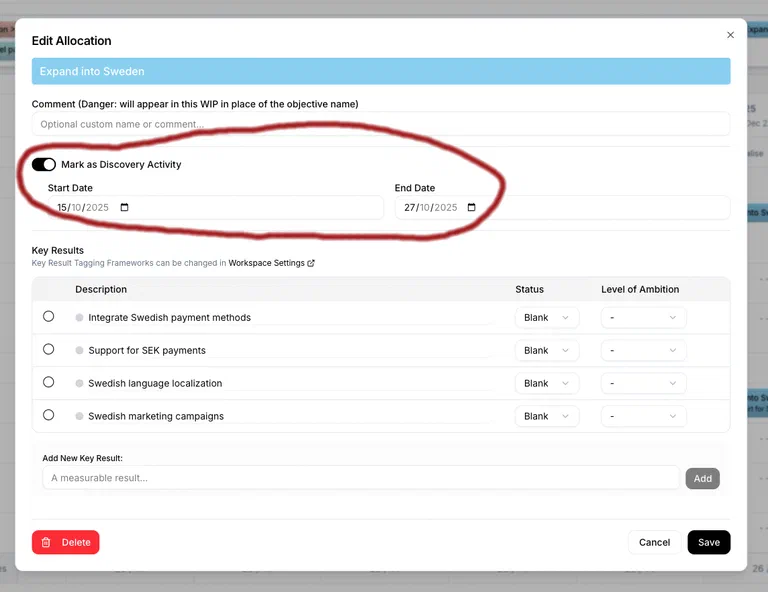 The Edit Allocation modal in RoadmapOne allows you to mark allocations as Discovery activities, making this critical work visible on your roadmap.
This small toggle creates enormous clarity. Product managers can now:
- Plan discovery sprints explicitly - Allocate 1-2 sprints for discovery before committing to delivery timelines (and account for this in your capacity-based planning )
- Balance discovery and delivery visually - See at a glance whether teams have appropriate discovery capacity
- Defend discovery time to stakeholders - Point to specific roadmap allocations that represent learning and validation work
- Track discovery across multiple objectives - Understand which initiatives are in discovery phase vs. delivery phase
How Discovery Appears in the Roadmap View
When an allocation is marked as discovery, it appears distinctly in the roadmap grid. Discovery activities are visually differentiated from delivery allocations, creating instant visibility into what each squad is working on.
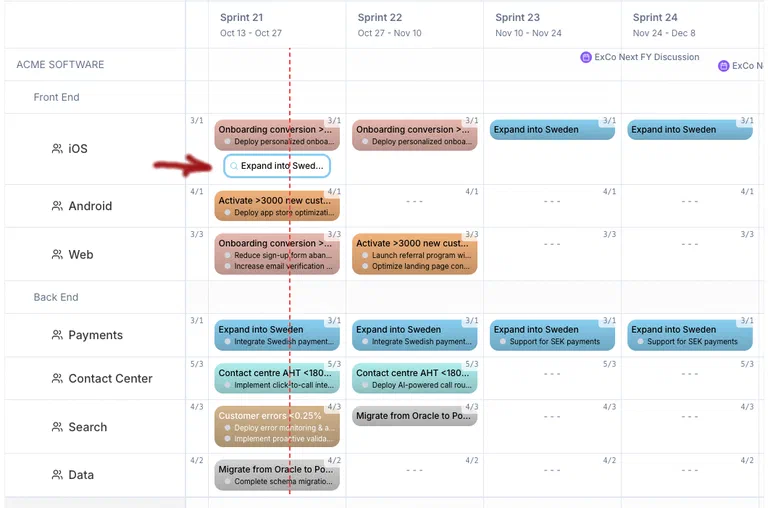 Discovery activities appear clearly in the roadmap view, showing which squads are in learning mode vs. delivery mode for each sprint.
This visual distinction helps teams and stakeholders have more nuanced conversations:
- “Squad A is in discovery on the retention objective for the next two sprints, then they’ll move to delivery.”
- “We have three squads in discovery this quarter—that’s appropriate given we’re exploring new market segments.”
- “This objective has been in discovery for six sprints. What have we learned? Is it time to move to delivery or pivot?”
The roadmap becomes a tool for strategic conversation, not just feature tracking.
Tracking Discovery Capacity in Analytics
Visibility in the roadmap is just the beginning. RoadmapOne also includes discovery allocations in analytics, giving leadership quantitative insights into how teams allocate their capacity.
Discovery vs. Delivery Analytics
The analytics dashboard can now show:
Percentage of capacity dedicated to discovery - Across the entire organization, specific tribes, or individual squads. Is your organization investing 10% in discovery? 25%? 5%? Now you know.
Discovery capacity by quarter - Track how discovery investment changes over time. Are you frontloading discovery early in the planning year, then shifting to delivery? Or maintaining continuous discovery throughout?
Discovery allocation by objective type - Are teams doing more discovery on customer-facing objectives vs. internal efficiency objectives? This helps ensure discovery effort aligns with strategic priorities.
Squad-level discovery patterns - Some squads may need more discovery time due to higher uncertainty or newer problem spaces. Analytics help you spot outliers and have coaching conversations.
Measuring Discovery Effectiveness
Beyond tracking discovery capacity, teams should measure discovery outcomes:
Validated ideas per sprint - How many assumptions did the team test? How many ideas were validated vs. invalidated? A high invalidation rate isn’t failure—it’s efficient learning. These validated outputs then feed into your objective prioritisation process.
Cycle time between discovery activities - How many days since the last customer interview? Since the last assumption test? Work to reduce these intervals.
Time to first validation - When starting discovery on a new objective, how quickly does the team reach their first meaningful validation point? Faster is better.
Ideas discarded - Track how often solutions are thrown out. If teams never discard ideas, they’re probably not testing rigorously enough—this is one of the core metrics covered in measuring discovery success .
Progress toward desired outcomes - Ultimately, measure discovery by charting progress toward outcomes like engagement or conversion, quarter over quarter. Improving discovery practices should correlate with improved outcome velocity.
These metrics help teams manage discovery as a discipline, not just an art.
Balancing Discovery and Delivery Across Your Organization
Different teams and different objectives require different discovery-to-delivery ratios. Here’s how to think about appropriate balance.
When to Invest More in Discovery
Increase discovery allocation when:
Uncertainty is high - New markets, new customer segments, or novel problem spaces require extensive discovery before committing to delivery.
Stakes are high - Strategic bets that could define the company’s next three years deserve thorough discovery to reduce risk.
Past delivery failed - If teams shipped features that didn’t drive intended outcomes, it’s a signal to invest more in discovery upfront.
You’re exploring vs. executing - Innovation initiatives and new product lines need higher discovery ratios than incremental improvements to established products.
When to Invest More in Delivery
Shift toward delivery when:
The solution is well-validated - Discovery has produced clear insights, and the path forward is understood.
You’re scaling what works - Taking a validated solution to additional customer segments or markets is primarily a delivery challenge.
Technical debt is blocking progress - Sometimes teams know exactly what customers need, but infrastructure limitations prevent delivery. Focus on delivery work that unblocks future discovery.
Time-sensitive opportunities exist - Market windows, competitive pressures, or regulatory deadlines sometimes require bias toward delivery.
The key is making these decisions explicitly rather than defaulting to delivery because it feels more “productive.”
Common Product Discovery Mistakes to Avoid
Even teams committed to discovery often fall into predictable traps.
Doing Too Little—Or Too Much—Discovery
When teams don’t do enough discovery, they end up in what some call the “stupid zone”—building things nobody wants. But too much discovery wastes time in endless research without committing to solutions.
Use clear decision gates: What do we need to learn to commit to delivery? Once you’ve validated those key assumptions, move forward. This is a strong argument for time-boxed discovery —a fixed capacity envelope forces the decision gate to arrive rather than letting exploration drift indefinitely.
Leaving Validation Until the End
Many teams mistakenly believe validation comes at the end of the process. By then, you’ve already committed significant resources to a direction that may be fundamentally flawed.
Validate continuously. Test the riskiest assumptions first. Get comfortable discarding ideas early.
Conducting Research in Silos
When product, design, and engineering each conduct their own research in isolation, insights don’t integrate, and teams don’t build shared understanding.
Discovery must be collaborative. The product trio should participate together in customer interviews, prototype testing, and assumption validation.
Focusing Only on Pre-Launch Research
The biggest discovery mistake is treating it as a phase that happens once before launch, then stopping.
Effective product discovery is continuous. Customer needs evolve. Market conditions change. What worked last quarter might not work next quarter. Maintain regular customer touchpoints throughout the entire product lifecycle. For the full catalogue of anti-patterns to watch for, see common product discovery mistakes .
Confirmation Bias
Teams often unconsciously favor information that confirms their pre-existing beliefs while disregarding contradictory evidence.
Combat confirmation bias by actively seeking disconfirming evidence. Ask “What would need to be true for this idea to fail?” Test those conditions explicitly.
Best Practices for Effective Product Discovery
Based on SVPG’s frameworks and insights from leading product organizations, here are practices that consistently produce better discovery outcomes.
Integrate Discovery with Delivery
Don’t separate teams into discovery and delivery. Use the same cross-functional team for both. Everyone owns both the problem and the solution.
If you want discovery work included in each sprint, it must live in the same backlog as delivery work. Prioritize all work in one place, forcing conscious trade-offs between discovery and delivery.
Use Dual-Track Agile
Run discovery and delivery in parallel. While some team members are discovering what to build next, others are delivering previously validated solutions.
This keeps both activities moving continuously without the stop-start inefficiency of sequential phases.
Make Discovery Tangible
Use visual tools like Opportunity Solution Trees, story maps, and assumption boards. These artifacts make discovery work concrete, allowing teams and stakeholders to critique and collaborate effectively.
Include discovery stories in your sprint boards. Track them. Review them. Celebrate completed discovery work just as you celebrate shipped features.
Create Psychological Safety
Discovery only succeeds when teams feel safe to explore, fail, and learn. Product managers and leaders must actively create environments where:
- Questions are welcomed, not seen as challenges to authority
- Failed experiments are treated as valuable learning, not performance issues
- Teams can say “This isn’t working” without fear of blame
- Different perspectives and expertise are genuinely valued
Start with the Riskiest Assumptions
Don’t test easy assumptions first. Identify what would kill the idea if it’s false, then test that assumption immediately.
If the risky assumption proves false, you’ve saved enormous time and effort. If it proves true, you’ve gained confidence to proceed.
Measure Learning, Not Just Activity
It’s easy to count customer interviews conducted or prototypes created. But SVPG reminds us that what teams are really searching for are insights, not just learning.
Focus on what you learned and how it changes your strategy. Did this discovery activity move the team closer to a viable solution? Did it help break down the objective into clearer key results?
From Discovery to Delivery: Making the Transition
Discovery shouldn’t last forever. At some point, teams need to commit to delivery. How do you know when to make that transition?
Clear Decision Criteria
Establish upfront what needs to be validated before moving to delivery:
- Have we confirmed this problem matters to enough customers?
- Have we identified at least one solution approach that tests positively?
- Do we understand the technical feasibility and can estimate effort?
- Have we defined success metrics and can measure them?
- Does the expected value justify the expected investment?
When you can answer “yes” to these questions, you’re ready to shift from discovery to delivery.
Continuous Discovery During Delivery
Even after committing to delivery, continue discovery activities at a smaller scale. Keep talking to customers. Keep testing assumptions. Keep learning.
The best product teams never fully leave discovery mode—they just shift the ratio between discovery and delivery based on where they are in the product lifecycle .
Learning from Delivery
Delivery itself generates insights. How customers actually use features often surprises teams. Usage data, support tickets, and customer feedback during delivery should feed back into ongoing discovery.
This creates a continuous loop: Discovery informs delivery. Delivery validates discovery. New questions from delivery spark new discovery activities.
Deeper Dives: Specialized Discovery Topics
While this guide provides a comprehensive overview of product discovery in roadmaps, several topics deserve deeper exploration. We’ve created detailed guides on specific aspects of discovery practice:
Time-Boxed Discovery: Why Concentrated Discovery Beats Drip-Drip Validation — Learn why allocating 1-2 full sprints to intensive discovery produces better validation outcomes and more honest capacity planning than letting discovery drip along for months. Discover how time-boxed discovery eliminates context switching, enables cross-functional coordination, and transforms discovery into your operational efficiency advantage.
From Objectives to Key Results: How Product Managers Lead the Discovery Breakdown — Master the most critical PM leadership moment: facilitating the collaborative discovery process where teams transform broad business objectives into specific, validated, measurable key results. Learn how to engage teams with opportunities, guide the objective-to-KR breakdown, build psychological safety for experimentation, and use Key Result tagging frameworks to ensure quality outcome commitments.
Common Product Discovery Mistakes to Avoid — Explore the most frequent discovery anti-patterns that undermine team effectiveness, from doing too little (or too much) discovery to leaving validation until the end, conducting research in silos, and falling prey to confirmation bias.
Product Discovery for Remote and Distributed Teams — Discover how remote teams can conduct effective discovery despite geographic separation, including asynchronous research methods, virtual workshop facilitation, and tools that enable distributed discovery collaboration.
Measuring Discovery Success: Metrics That Matter — Learn which discovery metrics actually predict better product outcomes, from experiment success rates and cycle time to ideas discarded and confidence evolution, plus how to avoid measurement theater.
Allocating Discovery Capacity Across Your Organization — Understand how to balance discovery and delivery capacity at the organizational level, including when to invest more in discovery, how to handle discovery allocation for different team types, and portfolio-level discovery planning.
Leading Discovery Activities as a Product Manager — Master the facilitation and leadership skills that make discovery workshops productive, including how to engage teams with opportunities, build psychological safety for experimentation, and guide the breakdown from objectives to key results.
GIST Framework: You Probably Already Have This Under Different Names — GIST (Goals, Ideas, Steps, Tasks) offers a layered planning framework from strategy to execution. Learn how it compares to OKRs, when the confidence meter concept is genuinely useful for tracking idea validation over time, and why you probably don’t need the full framework if you already have OKRs and a prioritisation model.
Opportunity Solution Trees: Discovery That Maps to Roadmap Reality — Teresa Torres’ Opportunity Solution Tree connects outcomes to opportunities to solutions to experiments. Learn how OST maps directly to roadmap planning: Outcomes become Objectives, validated Solutions become Key Results, and the tree structure ensures every delivery item traces back to a customer opportunity.
Impact Mapping: Always Think About the User — Gojko Adzic’s Impact Mapping forces the question most roadmaps ignore: who are we building for, and what behaviour change do we need from them? Discover why the Actors layer is essential during discovery, especially for B2B products with complex stakeholder maps.
Double Diamond: Process Framework That Needs a Time-Box — The Double Diamond describes how to do discovery—diverge, converge, diverge, converge. Learn why it’s a process framework rather than a prioritisation framework, and why without explicit time-boxing and capacity allocation it becomes an excuse for endless exploration.
Conclusion: Making Discovery a Strategic Advantage
Product discovery isn’t overhead—it’s your competitive advantage. Teams that discover effectively build the right things. They waste less effort on features nobody wants. They achieve business objectives faster because they’re not burning sprints on false starts.
But discovery only works if it’s visible, valued, and measurable. When discovery activities live in the shadows—tracked in spreadsheets or not tracked at all—they become the first casualty of delivery pressure.
By making discovery visible in your roadmap and tracking discovery capacity in your analytics, you transform how your organization thinks about product work. Discovery becomes a first-class activity, not an afterthought. Product managers can defend discovery time with data. Leadership can see whether teams have appropriate discovery capacity for their level of uncertainty.
Most importantly, discovery becomes the strategic moment where product managers lead their teams in breaking down ambitious business objectives into specific, testable key results. It’s where teams engage with problems, get excited about opportunities, and take ownership of outcomes.
That’s not overhead. That’s how great products get built.
Frequently Asked Questions
How can continuous discovery strengthen product roadmaps?
Continuous discovery strengthens a product roadmap by ensuring every initiative on the plan has already been de-risked before a squad commits delivery capacity to it. Instead of a quarterly research phase followed by nine months of build, the roadmap contains a visible, ongoing discovery stream—weekly customer contact, live assumption testing, evolving opportunity maps—so when an objective moves into delivery, the direction is informed rather than guessed. The result is fewer wasted sprints, higher confidence in stated priorities, and a plan that the Exco can actually defend to the board.
How do product managers validate roadmap decisions using research data?
Product managers validate roadmap decisions by breaking each objective down into its riskiest assumptions, then using research data—customer interviews, usage analytics, prototype testing, and rapid experiments—to either confirm or kill each assumption before delivery capacity is committed. The research doesn’t decide the roadmap on its own; it raises or lowers confidence on specific opportunities. Prioritisation then reflects that confidence alongside business value, effort, and strategic fit, which is why tools like RoadmapOne let PMs explicitly tag which allocations are still in discovery versus already validated.
What is the difference between product discovery and product delivery?
Product discovery is the work of uncovering what’s worth building—identifying customer problems, validating solution ideas, and reducing uncertainty before engineering capacity is committed. Product delivery is the work of building, shipping, and operating what discovery has validated. In the SVPG / dual-track agile model popularised by Marty Cagan, the same cross-functional squad does both continuously: discovery is typically led by the PM and designer, delivery is typically led by engineering, and everyone shares the context.
How long should product discovery take?
Most validated discovery cycles run one to two sprints per opportunity, not one to two quarters. The right duration is “as long as it takes to resolve the riskiest assumptions,” which is why time-boxing matters—a fixed two-sprint discovery envelope forces the team to prioritise which assumptions they have to test versus which are merely nice to know. Discovery that runs longer than four sprints without a decision gate is usually procrastination dressed up as rigour.
What is the right discovery-to-delivery ratio?
Teresa Torres and other practitioners recommend roughly 75% discovery / 25% delivery of the team’s learning capacity—which in practice translates to the product trio spending about 80% of its time in discovery while the rest of the engineers spend about 80% on delivery. The ratio shifts with maturity: new product lines and unvalidated opportunities need more discovery; scaling a known solution into additional markets tilts toward delivery. The right answer is one you can point to on the roadmap and deliberately defend, not one left implicit.
References and Further Reading
- Marty Cagan, INSPIRED: How to Create Tech Products Customers Love
- Teresa Torres, Continuous Discovery Habits
- SVPG Articles on Product Discovery
- Jeff Gothelf, “Making Time for Product Discovery”
- Nielsen Norman Group, “Discovery in Agile”
