Topic: Roadmapping (42 articles)

RoadmapOne 4.0: WIP Limits, JIRA Integration, and SAFe Support
The biggest release yet — plan smarter, integrate deeper, and ship with confidence
RoadmapOne 4.0 is here — WIP Limits, JIRA Integration, SAFe support, collapsible teams, and a host of improvements to help you plan smarter.

How to Present a Product Roadmap to the Board
The Board Isn't There to Approve Your Roadmap. It's There to Improve It.
What a board actually judges when you present a product roadmap — and why Run, Grow and Transform need three completely different conversations. From someone who sits on the other side of the table.

Theme-Based Roadmaps: A Lens, Not a Plan
How to Tag Objectives by Growth Lever and Check the Investment Matches the Financial Plan
Themes are not a way to plan a roadmap — they are a lens over it. How to tag objectives by the growth levers your board already recognises, check that investment matches the financial plan, and avoid the colour-coded decoration that passes for a theme-based roadmap.

How to Balance Multiple Product Roadmaps Against One Pool of Engineering Capacity
Stop Protecting Teams From Change. Move Them to the Problem Worth Solving.
Multiple products, one pool of engineering capacity, and every product wants more. Balancing multiple product roadmaps is not a template problem. It is an organisational muscle: the ability to move teams to the problem worth solving, cheaply and without drama. Here is how to build it.

Does Your Capacity Actually Match Your Growth Plan?
The board signs off a 40% growth plan. Engineering capacity, honestly audited, shows 8% of squad-sprints allocated to growth work. Both numbers cannot be true. The arithmetic that reconciles them is what every business plan relies on and almost no product organisation actually does — and it's the single most productive thing a CPO, CTO or NED can put on the table.

Punctuated Equilibrium: Why a Two-Week Sprint Is Two Weeks
Every agile team does two-week sprints, and almost nobody can tell you why two weeks. The answer is borrowed from evolutionary biology. Eldredge and Gould's theory of punctuated equilibrium explains why a two-week rhythm is the engineered punctuation of organisational stasis — and why a one-week cadence exhausts teams while a four-week cadence lets decay set in.

Product Portfolio Roadmaps: Why Your Roadmap Is a Portfolio Allocation Decision, Not a Feature List
Very few companies have one product. Most are portfolios — multiple products at different lifecycle stages, each needing a different operating model, a different team shape, and a different share of the roadmap. The roadmap IS the portfolio allocation decision. Here's how to see your portfolio clearly, diagnose the common failure modes (including the 'CEO-interest-led' anti-pattern), and allocate capacity per product using the frameworks that actually work.

Business Case for a New Product: The 3-Page PID Template That Forces ExCo Alignment
A business case for a new product is not a forecast — it's the alignment artefact that forces every ExCo member to commit, in writing, to their functional contribution to the product's success. This article covers the tight 3-page Project Initiation Document (PID) template that took Trayport to 62% CAGR, why PE-owned companies are better at this than anyone else, and why nothing should be allowed onto the roadmap until the PID is signed.

AI Made Building Your Product Free. Crossing the Chasm Is Still Exactly Where It Always Was.
AI has collapsed the cost of building your product to near zero. The chasm between early adopters and the early majority is exactly where it always was — and it's wider than ever. Here's what that means for your roadmap, your team allocation, and the grown-up conversation your board needs to have.

Assumption Mapping: David Bland's 2×2 for Deciding What to Test First
Assumption mapping is the workshop discipline that tells a product team which assumption to test first. David Bland and Alex Osterwalder's 2×2 — importance × evidence — surfaces the 'leap of faith' assumptions that belong at the top of the discovery queue. In 2026, when building is nearly free, assumption mapping is the single highest-leverage hour a product team spends each quarter.

Diffusion of Innovations: Rogers' 5 Adopter Categories and the Technology Adoption Lifecycle
Everett Rogers' Diffusion of Innovations — the technology adoption lifecycle — describes the five adopter categories (innovators, early adopters, early majority, late majority, laggards) through which every new product passes. Here's what Rogers' framework actually means for your roadmap, your GTM motion, and why AI has made some adopter categories much harder to reach — and others much easier.

Early-Stage Product Validation: Seven Thinking Tools for 'Should This Idea Even Ship?'
Seven thinking tools for the stage before product-market fit — the stage where the honest answer to 'should this idea ship at all?' is usually no, or not yet, or not in this form. Problem-solution fit, riskiest assumption tests, assumption mapping, the Mom Test, MVP vs MLP vs MVA, Proof of Usefulness, and PMF measurement itself. Each framework answers a different question; sometimes the answer is 'stop validating and ship', sometimes it's 'stop building and listen'. This directory is for product leaders deciding which lens to pick up.

Gartner Hype Cycle: The 5 Phases and How to Use It for Roadmap Timing
The Gartner Hype Cycle plots emerging technologies through five phases — Innovation Trigger, Peak of Inflated Expectations, Trough of Disillusionment, Slope of Enlightenment, Plateau of Productivity. Here's how to use it as a roadmap tool rather than as conference wallpaper — when to bet on an emerging technology, when to wait, and why PE portfolio companies consistently get the timing wrong.

MVP vs MLP vs MVA: Minimum Viable, Lovable, or Awesome?
MVP, MLP, or MVA? Frank Robinson's Minimum Viable Product was designed to learn, not ship. Brian de Haaff's Minimum Lovable Product added an emotional bar. Minimum Viable Awesome (or Minimum Awesome Product) argues that in 2026 'minimum' is the wrong target entirely. When building is nearly free, the only defensible goal is magnificent in at least one dimension — your crown jewel.

Platform Business Models: Why Network Effects Are the Only Moat AI Cannot Erode
Platform business models — marketplaces, multi-sided platforms, ecosystems — don't sell products. They orchestrate exchanges between participants and capture a share of the value. In the AI era, where build cost has collapsed, network effects are the one remaining moat that AI cannot erode. Here's what that means for your roadmap, your PE valuation, and why platform plays dominate the next decade.

Problem-Solution Fit: The Stage Before PMF (And Why It Matters More Now)
Problem-solution fit is the stage before product-market fit — the one where you prove the problem is worth solving before you spend a penny on building a solution. In the AI era, when building is nearly free, problem-solution fit is the only discipline that stops teams from shipping ten wrong products in the time it used to take to ship one.

Product Life Cycle Stages: What Your Roadmap Should Look Like at Each Stage
The product life cycle has four stages — introduction, growth, maturity, decline — and every marketing textbook will tell you what they are. Almost none tell you what you actually need to know: how your roadmap, team shape, and resource allocation must change at each stage. Here's the operating-model view of the product life cycle.

Product Lifecycle Models: Nine Thinking Tools for Smarter Product Roadmap Decisions
Product lifecycle models are thinking tools. Each one helps you reason about where a specific product currently lives and what it genuinely needs next — which may not be more engineering investment at all, but a different go-to-market motion. This directory covers nine lifecycle frameworks, each designed to prompt a different diagnostic question.

Product-Market Fit: How to Measure It Honestly (Ellis, Vohra, Rachleff)
Product-market fit is the only milestone that matters for an early-stage product. AI has collapsed the cost of building, so measuring PMF — using Sean Ellis's 40% test, the Rahul Vohra Superhuman engine, and retention cohorts — now matters more, not less. Here's how to measure it honestly, diagnose fake PMF from a board seat, and allocate a minimum viable team to hunt it down.

Proof of Usefulness: A Weighted Scorecard for Early-Stage Ideas
Proof of Usefulness is a weighted scorecard from HackerNoon (April 2026) that rates early-stage products on real-world utility, traction, reach, technical stability, timing, and completeness. It's not a canonical framework yet — but the weight distribution is a genuinely useful lens for boards and founders asking whether an early-stage bet is real or theatre. Here's how to borrow what works without swallowing it whole.

Riskiest Assumption Test (RAT): Testing What Could Kill Your Product First
A Riskiest Assumption Test (RAT) is the smallest possible experiment that can prove or kill the assumption most likely to sink your early-stage product. Rik Higham coined the term in 2016 as a corrective to the abuse of MVP. In 2026, when building is nearly free, the RAT is arguably the only unit of early-stage work worth funding.

S-Curves in Product Strategy: When to Jump to the Next Curve
The S-curve describes how most product and technology performance improves — slow at first, then rapid acceleration, then flattening as limits are approached. Here's how to recognise when your current S-curve is flattening, how to time the jump to the next curve, and why most companies miss the moment entirely.

The Innovator's Dilemma in the AI Era: Why Your Best Customers Will Kill Your Next Product
Clayton Christensen's Innovator's Dilemma explains why successful companies lose to disruptors they should have beaten. AI has made the problem worse, not better — disruptors now have near-zero build cost and only need to solve distribution. Here's what that means for your roadmap and how to protect your own disruptive bets from your own best customers.

The Mom Test: Customer Interviews That Don't Lie to You
Rob Fitzpatrick's The Mom Test (2013) is the canonical playbook for customer interviews that produce signal rather than polite lies. Talk about their life, not your idea. Ask about specific past behaviour, not hypothetical future intent. Extract commitment, not compliments. In 2026, when building is nearly free, Mom Test discipline is the single biggest separator of teams that find real products from teams that don't.

OKR Examples for Product Teams: 30+ Objectives and Key Results That Actually Work
Problems to Solve, Not Features to Build
30+ OKR examples for product teams—framed as business problems, not features. Includes bad-to-good rewrites, real-world examples from Google and Intel, examples tagged by Run/Grow/Transform, and how each Objective connects to squad allocation on your roadmap.

The Product Operating Model: A Practical Guide From Inside Cagan's Trainline Case Study
From Specs-Over-the-Wall to Empowered Teams — And the Tool We Built to Make It Work
The product operating model is how the best tech-powered companies work. I know because I was there — as CTO at Trainline, featured in Marty Cagan's Transformed. Here's what the product model actually looks like in practice, how we aligned 650 people around outcomes, and why I built RoadmapOne to make it repeatable.

The Culture of Adequacy: Your Customers Don't Want Minimum — They Want Magnificent
How Product Leaders Accidentally Train Teams to Be Mediocre
Many teams have been conditioned into adequacy: shipping the bare minimum of everything and the full potential of nothing. Here's the spectrum from Minimum Product to Maximally Awesome Product, and why your crown jewels deserve obsessive, beautiful, category-killing investment.

Crown Jewels: Why Your Most Important Feature Is Slowly Dying
Every product has two or three capabilities that disproportionately matter to customers. Over time, product teams lose sight of these crown jewels—until a competitor does them slightly better and the loss ratio spikes. Here's how to identify, protect, and relentlessly improve the features that define your product.

Ship It and Move On: The Recipe for a Mediocre Product
Great Features ALWAYS Need a Second Act
Your roadmap shows Feature X shipping in March, then the team immediately moves on. That's the recipe for a mediocre product—an agglomeration of half-baked MVPs where nothing makes customers go 'wow'. Here's why great products need a second act.

Initiative vs Epic vs Story vs Task: A Clear Hierarchy for Your Roadmap
Initiative, epic, story, task—the hierarchy of work items confuses almost every product team. Here's how to think about it clearly and what actually matters for your roadmap.

Now Next Later Roadmaps: The Simple Framework That Oversimplifies Strategy
Now Next Later roadmaps are popular for their simplicity, but they hide critical capacity constraints and let teams avoid hard prioritisation decisions. Here's why I'm skeptical—and what to use instead.

OKR vs Roadmap: They're Not Competing (Here's How They Connect)
OKRs and roadmaps aren't competing approaches—they're complementary tools. Learn how to connect your Objectives and Key Results to your product roadmap for strategic alignment that actually works.

Outcome-Based Roadmaps: A Practical Guide for Product Teams
Outcome-based roadmaps focus on measurable business results rather than feature lists. Learn how to shift from output-driven planning to outcome-focused product strategy that aligns teams, satisfies boards, and actually moves the needle.

Product Roadmap vs Product Backlog: Different Tools, Different Jobs
Product roadmaps and backlogs serve different purposes for different audiences. Conflating them—or using Jira as your roadmap—is a recipe for strategic confusion and tactical chaos.

Quarterly Roadmap Planning: The Cadence That Actually Works
Quarterly roadmap planning hits the sweet spot—short enough to avoid wasting resources on the wrong things, long enough to achieve meaningful outcomes. Here's how to run a quarterly planning cycle that actually works.

Should You Have a Public Roadmap? A SaaS Decision Framework
Should your SaaS company publish a public roadmap? The answer is 'it depends'—but I've seen public roadmaps transform customer relationships when done right. Here's a decision framework, including a story about a customer who literally shouted in my face.

Vision vs Strategy vs Roadmap: Understanding the Product Hierarchy
Vision, strategy, and roadmap form a hierarchy that most teams collapse or skip entirely. Here's how to think about each level clearly—and why missing the strategy layer is the most common failure.

Capacity-Based Roadmap Planning: Why Resource Allocation Matters More Than Feature Lists
PowerPoint roadmaps promise 47 initiatives. You have 12 squads and 26 sprints. The math doesn't work. Learn how capacity-based roadmap planning forces honest conversations about what actually fits—and why showing stakeholders the capacity constraint is your secret weapon for managing expectations.

Master Roadmaps vs. Scenario Planning: How to Plan for Multiple Futures Without Losing Your Mind
What if the budget gets cut 30%? What if we pivot to enterprise? What if the acquisition happens? Scenario planning lets you explore alternatives without destroying your master roadmap. Learn how to create, compare, and convert scenarios—without the version control chaos that kills strategic planning.

Milestones in Product Roadmaps: How to Track External Events, Board Meetings, and Governance Dates Without Chaos
Most roadmap tools mix milestones with delivery work, creating confusion about what's being shipped vs. what's happening externally. Learn how to track board meetings, product launches, conferences, and regulatory deadlines as first-class roadmap elements—ensuring teams plan backwards from constraints that matter.

Introducing RoadmapOne Version 3
Your Feedback Made This
RoadmapOne Version 3 is here—featuring full collaborative editing, first-class Discovery activities, customizable Objective Prioritisation with 15 frameworks, expanded Key Result and Objective tagging, plus major performance improvements. Built on your feedback.
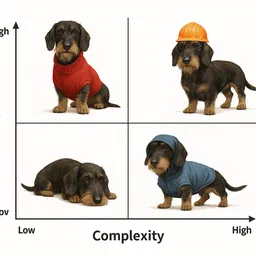
Value vs Complexity Matrix: The Visual Prioritisation Framework for Product Teams
Visual Clarity for Teams Who Think in Quadrants, Not Numbers
The Value vs Complexity Matrix is a visual 2×2 prioritisation grid that sorts every objective into Quick Wins, Major Projects, Fill-ins, or Money Pits. Plot value against complexity and see your entire roadmap at a glance.
